
Few scientists have changed the world as profoundly as Marie Curie. Her groundbreaking discoveries in radioactivity transformed medicine, physics, and chemistry while opening entirely new fields of scientific research. More than a century after her greatest achievements, her name remains synonymous with perseverance, intelligence, and innovation.
When people search for interesting facts about Marie Curie, they often discover much more than a list of scientific accomplishments. Marie Curie was the first woman to win a Nobel Prize, the first person to receive Nobel Prizes in two different sciences, and a pioneer who continued her work despite significant social and personal challenges.
Her story is not only about laboratories and experiments. It is also about determination, family, sacrifice, and a lifelong commitment to knowledge. From her childhood in Poland to her historic achievements in France, Marie Curie’s life continues to inspire students, researchers, and curious minds around the world.
This complete guide explores her history, major accomplishments, lesser-known facts, and the lasting impact she continues to have on modern science.
Quick Facts About Marie Curie
| Detail | Information |
| Full Name | Maria Salomea Skłodowska-Curie |
| Born | November 7, 1867 |
| Birthplace | Warsaw, Poland |
| Died | July 4, 1934 |
| Nationality | Polish and French |
| Profession | Physicist and Chemist |
| Famous For | Research on radioactivity |
| Nobel Prizes | Physics (1903), Chemistry (1911) |
| Husband | Pierre Curie |
| Children | Irène and Ève Curie |
| Discoveries | Polonium and Radium |
Background and Early Life

Marie Curie was born as Maria Skłodowska in Warsaw when Poland was under Russian control. Growing up, she experienced political oppression and limited educational opportunities for women. Despite these obstacles, she excelled academically and developed a passion for science at an early age.
Her family deeply valued education. Both of her parents were teachers, and they encouraged intellectual curiosity. However, financial struggles made pursuing higher education difficult.
To support her studies, Marie worked as a governess for several years before moving to Paris in 1891. She enrolled at the Sorbonne (University of Paris), where she studied physics and mathematics. Living in modest conditions, she often skipped meals to afford tuition, yet she graduated at the top of her class.
Her journey from a young Polish student to one of history’s greatest scientists remains one of the most inspiring stories in science.
The History of Marie Curie’s Scientific Career
Marie Curie’s scientific career began in earnest after meeting Pierre Curie, a respected physicist. The two married in 1895 and formed one of the most influential scientific partnerships in history.
In 1896, physicist Henri Becquerel discovered that uranium emitted mysterious rays. Fascinated by this phenomenon, Marie chose it as the subject of her doctoral research. She coined the term “radioactivity” and spent years studying radioactive materials.
By 1898, Marie and Pierre announced the discovery of two new elements:
- Polonium
- Radium
Their discoveries revolutionized science and led to significant advancements in medicine, particularly cancer treatment.
In 1903, Marie Curie shared the Nobel Prize in Physics with Pierre Curie and Henri Becquerel. Following Pierre’s tragic death in 1906, Marie became the first woman professor at the University of Paris.
She later received the Nobel Prize in Chemistry in 1911, cementing her place as one of the most accomplished scientists in history.
Timeline of Marie Curie’s Life
- 1867 – Born in Warsaw, Poland.
- 1891 – Moved to Paris to study.
- 1895 – Married Pierre Curie.
- 1898 – Discovered polonium and radium.
- 1903 – Won Nobel Prize in Physics.
- 1906 – Became the first female professor at the Sorbonne.
- 1911 – Won Nobel Prize in Chemistry.
- 1914 – Helped establish mobile X-ray units during World War I.
- 1934 – Passed away due to aplastic anemia.
10 Interesting Facts About Marie Curie
Marie Curie was one of the most remarkable scientists in history. She made groundbreaking discoveries in the field of radioactivity and changed the way people understand science. Her dedication, hard work, and passion for research helped her achieve things that few scientists had accomplished during her lifetime.
There are many fascinating details about her personal life and scientific career that make her story worth exploring. From her early struggles in education to her historic Nobel Prize achievements, these 10 interesting facts about Marie Curie reveal why she remains an inspiration to students, researchers, and science lovers around the world.
What Is Marie Curie Famous For?
Marie Curie is famous for her pioneering research on radioactivity and her discovery of two chemical elements, polonium and radium. Her scientific work opened new doors in physics and chemistry and helped researchers better understand radioactive materials.
She is also remembered for becoming the first woman to win a Nobel Prize and the first person to receive Nobel Prizes in two different scientific fields. Her achievements made her one of the most influential figures in the history of modern science.
Marie Curie’s Inventions and Scientific Discoveries
Marie Curie is best known for her discoveries rather than for inventing everyday machines or products. Alongside her husband, Pierre Curie, she discovered polonium and radium in 1898. Her research also helped establish important methods for studying and measuring radioactive substances.
During World War I, she helped develop mobile X-ray units, often called “Little Curies,” which allowed doctors to examine injured soldiers closer to the battlefield. These efforts showed how scientific research could be used to save lives and improve medical care.
Marie Curie’s Nobel Prize Achievements
Marie Curie made history by winning the Nobel Prize in Physics in 1903, which she shared with Pierre Curie and Henri Becquerel for their work on radiation. This achievement made her the first woman to receive a Nobel Prize and brought international recognition to her scientific research.
In 1911, she received the Nobel Prize in Chemistry for her discoveries of radium and polonium and her investigation of radium’s properties. She remains the first person to win Nobel Prizes in two different scientific disciplines, making her achievements truly extraordinary.
5 Interesting Facts About Marie Curie
Marie Curie’s life is full of achievements that continue to surprise people. She was born in Poland, moved to Paris to pursue higher education, and became a leading scientist at a time when women faced major barriers in academic research. Her determination helped her overcome many challenges.
Another fascinating fact is that she worked with radioactive materials before their health risks were fully understood. She also helped introduce mobile X-ray services during World War I. Her discoveries and dedication made a lasting contribution to science and medicine.
3 Interesting Facts About Marie Curie
Three particularly interesting facts about Marie Curie stand out. First, she was the first woman to win a Nobel Prize. Second, she discovered two chemical elements, polonium and radium, through her research with Pierre Curie. Third, she became the first person to win Nobel Prizes in two different scientific fields.
These achievements were remarkable for her time and helped change the history of science. Her story demonstrates how curiosity, determination, and years of dedicated research can lead to discoveries that benefit future generations.
Interesting Facts About Marie Curie for Kids
Marie Curie is an excellent example of someone who followed her curiosity and worked hard to achieve her dreams. She loved learning about science from an early age and later moved to France to study at the University of Paris. Her discoveries helped scientists understand radioactivity.
One fun fact for children is that she helped bring X-ray machines to battlefields during World War I so doctors could examine wounded soldiers. She also won two Nobel Prizes, which is an incredible achievement. Her life teaches children the importance of education, patience, and never giving up.
10 Interesting Facts About Marie Curie for Kids
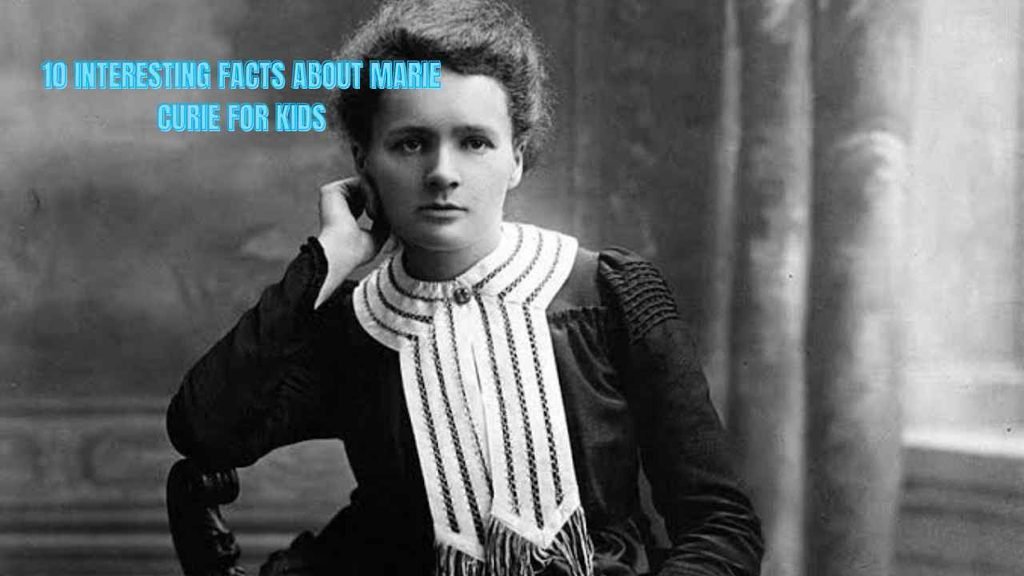
There are many simple and exciting things children can learn about Marie Curie. She was born in Warsaw, Poland, in 1867, studied science in Paris, and became famous for her research on radioactive elements. She discovered polonium and radium and helped make important scientific progress.
Marie Curie also became the first woman to win a Nobel Prize and the first person to receive Nobel Prizes in two different scientific fields. Her work during World War I helped doctors use X-rays to treat injured soldiers. These facts show children how one person’s curiosity and determination can make a difference in the world.
20 Interesting Facts About Marie Curie
1. Marie Curie Was the First Woman to Win a Nobel Prize
In 1903, Marie Curie became the first woman ever awarded a Nobel Prize. At a time when women were rarely recognized in science, this achievement broke barriers and inspired generations of female scientists.
Her success demonstrated that talent and determination could overcome social limitations.
2. She Won Nobel Prizes in Two Different Sciences
Marie Curie remains the only person to win Nobel Prizes in Physics and Chemistry. She received the Physics Prize in 1903 and the Chemistry Prize in 1911.
This extraordinary accomplishment highlights the breadth of her scientific contributions.
3. She Coined the Word “Radioactivity”
The term “radioactivity” did not exist before Marie Curie’s research. She introduced the word to describe the energy emitted by certain elements.
Today, the term is used in countless scientific disciplines worldwide.
4. She Discovered Two Elements
Marie Curie and Pierre Curie discovered polonium and radium in 1898. Polonium was named after Poland, honoring her homeland.
These discoveries significantly advanced scientific understanding of atomic structure.
5. Marie Curie Worked Under Difficult Conditions
Her laboratory was little more than a converted shed. She spent years stirring heavy containers of minerals and conducting experiments with limited resources.
Despite these challenges, she achieved discoveries that changed modern science forever.
6. She Was the First Female Professor at the Sorbonne
After Pierre Curie’s death, Marie took over his teaching position at the University of Paris in 1906.
Her appointment marked a historic moment for women in higher education and academia.
7. Her Notebooks Are Still Radioactive
One of the most fascinating facts about Marie Curie is that her laboratory notebooks remain radioactive today.
They are stored in lead-lined boxes, and researchers must wear protective equipment to access them.
8. She Helped Save Soldiers During World War I
During World War I, Marie Curie developed mobile X-ray units known as “Little Curies.”
These vehicles allowed doctors to diagnose injuries near battlefields, helping save thousands of lives.
9. She Learned French After Moving to Paris
Although she became one of France’s most celebrated scientists, French was not her first language.
Marie mastered French while pursuing her studies and later published influential scientific papers in the language.
10. She Faced Significant Gender Discrimination
Many scientific institutions initially refused to recognize her achievements because she was a woman.
Nevertheless, Marie Curie continued her work and became one of history’s most respected scientists.
11. Her Daughter Also Won a Nobel Prize
Marie Curie’s daughter, Irène Joliot-Curie, won the Nobel Prize in Chemistry in 1935.
This made the Curie family one of the most distinguished scientific families in history.
12. She Never Patented Radium Extraction
Marie Curie chose not to patent her methods for isolating radium.
She believed scientific discoveries should benefit humanity rather than generate personal wealth.
13. She Studied in Secret Educational Networks
Before leaving Poland, Marie participated in the “Flying University,” an underground institution that educated Polish students despite political restrictions.
This experience strengthened her commitment to education and intellectual freedom.
14. She Received Numerous Honors Worldwide
Universities and institutions across the globe awarded Marie Curie honorary degrees and medals.
Even today, schools, laboratories, and research institutes bear her name.
15. She Carried Radioactive Materials in Her Pockets
Marie Curie often carried small samples of radium because she was fascinated by their glow.
At the time, scientists did not fully understand the health risks associated with prolonged radiation exposure.
16. Marie Curie Became a French Citizen
Although born in Poland, Marie became a French citizen after marrying Pierre Curie.
She maintained strong ties to both countries throughout her life and is celebrated as a national icon in each.
17. She Was Exceptionally Determined
Marie Curie endured poverty, personal loss, and discrimination throughout her life.
Her resilience serves as a powerful reminder that persistence often leads to extraordinary achievements.
18. She Established Research Institutes
Marie founded important scientific institutions dedicated to radioactivity research.
The Curie Institutes in Paris and Warsaw continue conducting groundbreaking medical and scientific studies today.
19. Her Work Revolutionized Cancer Treatment
Modern radiation therapy owes much to Marie Curie’s discoveries.
Her research laid the foundation for treatments that have helped millions of cancer patients around the world.
20. Marie Curie’s Legacy Continues Today
More than 90 years after her death, Marie Curie remains one of the most influential scientists in history.
Her life story continues to inspire people to pursue education, challenge barriers, and contribute to society through knowledge.
Marie Curie’s Cultural and Historical Importance
Marie Curie occupies a unique place in both scientific and cultural history. She represents perseverance, intellectual freedom, and the pursuit of truth.
Her achievements are frequently highlighted in:
- School textbooks
- Museums
- Films and documentaries
- Scientific conferences
- Women’s history celebrations
In Poland, she is celebrated as a national hero. In France, she is remembered as a pioneer of modern science. Around the world, she symbolizes the importance of equal opportunities in education and research.
Her life has also become an enduring example of how science can transcend borders and unite humanity.
Famous Places Connected to Marie Curie
Several locations preserve Marie Curie’s legacy and attract visitors interested in science and history.
Curie Museum, Paris
Located in Paris, the museum contains personal items, photographs, and exhibits related to her scientific work.
Curie Institute
Founded by Marie Curie, this institute remains a leading center for cancer research and medical innovation.
Marie Curie Museum in Warsaw
Her birthplace in Warsaw has been transformed into a museum that highlights her life and achievements.
Panthéon, Paris
Marie Curie became the first woman honored in the Panthéon for her own accomplishments, joining France’s most distinguished historical figures.
Marie Curie’s Modern Impact
Marie Curie’s influence extends far beyond the scientific discoveries she made during her lifetime.
Her contributions continue to impact:
- Nuclear physics
- Medical imaging
- Cancer treatment
- Chemistry research
- STEM education
- Women’s participation in science
Many organizations use her story to encourage young people, particularly girls, to pursue careers in science, technology, engineering, and mathematics.
Additionally, annual events celebrating women in science often feature Marie Curie as a central figure due to her lasting influence on education and innovation.
Frequently Asked Questions About Marie Curie
Who was Marie Curie?
Marie Curie was a Polish-born French physicist and chemist best known for her pioneering research on radioactivity and the discovery of radium and polonium.
What are Marie Curie’s most famous discoveries?
Her most famous discoveries are the elements polonium and radium, along with her foundational work on radioactivity.
How many Nobel Prizes did Marie Curie win?
Marie Curie won two Nobel Prizes—Physics in 1903 and Chemistry in 1911.
Why is Marie Curie important today?
Her discoveries continue to influence medicine, physics, and cancer treatment, making her one of the most important scientists in history.
Did Marie Curie have children?
Yes. She had two daughters, Irène Joliot-Curie and Ève Curie. Irène later became a Nobel Prize-winning scientist.
What caused Marie Curie’s death?
Marie Curie died in 1934 from aplastic anemia, a condition linked to prolonged exposure to radiation.
Why are Marie Curie’s notebooks still radioactive?
Her notebooks contain radioactive contamination from her experiments. Due to the long half-life of radium, they remain hazardous today.
Conclusion
Marie Curie’s life was defined by curiosity, courage, and an unwavering commitment to science. From overcoming educational barriers in Poland to becoming a two-time Nobel Prize winner, she reshaped humanity’s understanding of the natural world.
These interesting facts about Marie Curie reveal a woman whose impact extends far beyond the laboratory. She pioneered scientific discoveries, saved lives through medical innovation, and inspired countless people to pursue knowledge without fear.
More than a historical figure, Marie Curie remains a symbol of what can be achieved through perseverance, education, and a desire to make the world better. Her legacy continues to shine brightly—much like the glowing radium that first captured her imagination over a century ago.

I am Olivia Bennett, a writer and quote enthusiast who loves turning everyday experiences into meaningful words. I believe that inspiration can be found in the smallest moments of life. Through my writing, I share thoughts about love, happiness, relationships, confidence, and hope. I want every quote I write to give readers something positive to think about.
Books
- Words That Touch the Heart
- Moments Worth Remembering
 Ethan Brooks